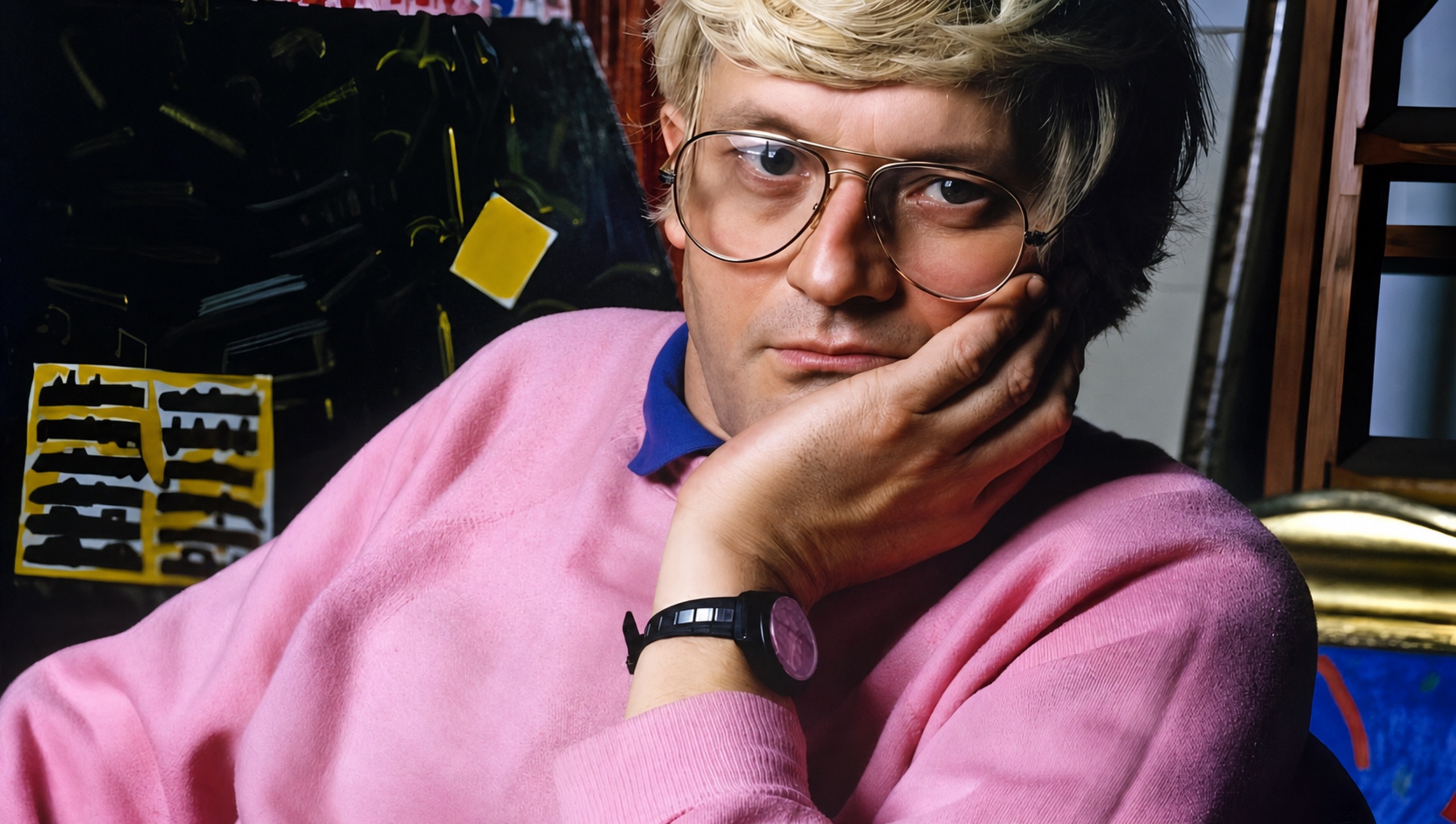

David Hockney occupies a rare position in modern art: he was simultaneously popular and intellectually restless, flamboyant and deeply serious, immediately recognisable yet almost impossible to contain within a single artistic category. His career cannot comfortably be reduced to British Pop Art, Californian painting, portraiture, landscape, photography or digital art, because Hockney spent his life moving between these territories with the curiosity of somebody who regarded artistic convention not as a boundary but as an invitation. He painted, drew, printed, photographed, designed opera sets, experimented with video and eventually embraced the iPhone and iPad. Across all of these transformations, however, one subject remained constant: the act of looking.
Born in Bradford, Yorkshire, on 9 July 1937, David Hockney was the fourth of five children of Kenneth and Laura Hockney. His upbringing was relatively modest, but the young Hockney possessed an unusually determined relationship with art. He attended Bradford School of Art from 1953 to 1957, where he received a traditional education grounded in life drawing, portraiture and observation. This early training is important because it establishes something that remained fundamental throughout his career: beneath the apparent simplicity and exuberance of his mature work was an exceptionally disciplined draughtsman. Hockney never abandoned drawing. Even when technology became increasingly important to him, the hand remained central.
His early years also reveal a young man unwilling to accept the prescribed route simply because it had been prescribed. As a conscientious objector, he fulfilled his National Service by working in hospitals between 1957 and 1959 rather than entering military service. He subsequently attended the Royal College of Art in London, where he encountered a generation of artists who would become central to the emergence of British Pop Art. His contemporaries included R. B. Kitaj, Allen Jones and Peter Blake, while visiting artists included Francis Bacon and Richard Hamilton. At the Royal College, Hockney's confidence rapidly developed, and in 1962 he received the college's Gold Medal.
Yet it would be misleading to describe Hockney simply as a Pop artist. He belonged to the atmosphere from which British Pop emerged, but his interests were more personal and psychologically expansive. His paintings incorporated words, literary references, private jokes and fragments of popular culture, while his increasingly open treatment of male desire gave his work an intimacy that distinguished him from much of the more impersonal visual language surrounding Pop Art. At a time when homosexuality remained socially and legally difficult in Britain, Hockney refused to conceal an important part of himself. His sexuality was not merely an additional biographical detail; it became one of the means through which he challenged the boundaries of what could be represented openly in contemporary painting.
This mixture of wit, independence and personal candour became central to his public persona. Hockney dressed with flamboyance, spoke with characteristic directness and cultivated an almost theatrical presence, yet behind the exuberance was a serious intellectual fascination with the mechanics of representation. He was fascinated by the deceptiveness of vision. What does it actually mean to see something? Does a photograph represent reality more truthfully than a painting? Can a single viewpoint ever adequately describe a human being or a landscape? Hockney's entire career can be understood as an extended attempt to dismantle the assumption that there is one correct way of seeing.
California transformed that investigation.
Hockney first travelled to Los Angeles in the early 1960s and found himself captivated by its extraordinary light, architecture, swimming pools and sense of possibility. In 1964 he moved decisively towards America, and the contrast between grey northern England and the brilliant surfaces of Southern California released a new chromatic vocabulary. The world he encountered there seemed almost theatrically constructed: palm trees, modernist houses, expanses of blue water and a sun so intense that architecture itself appeared to become colour.
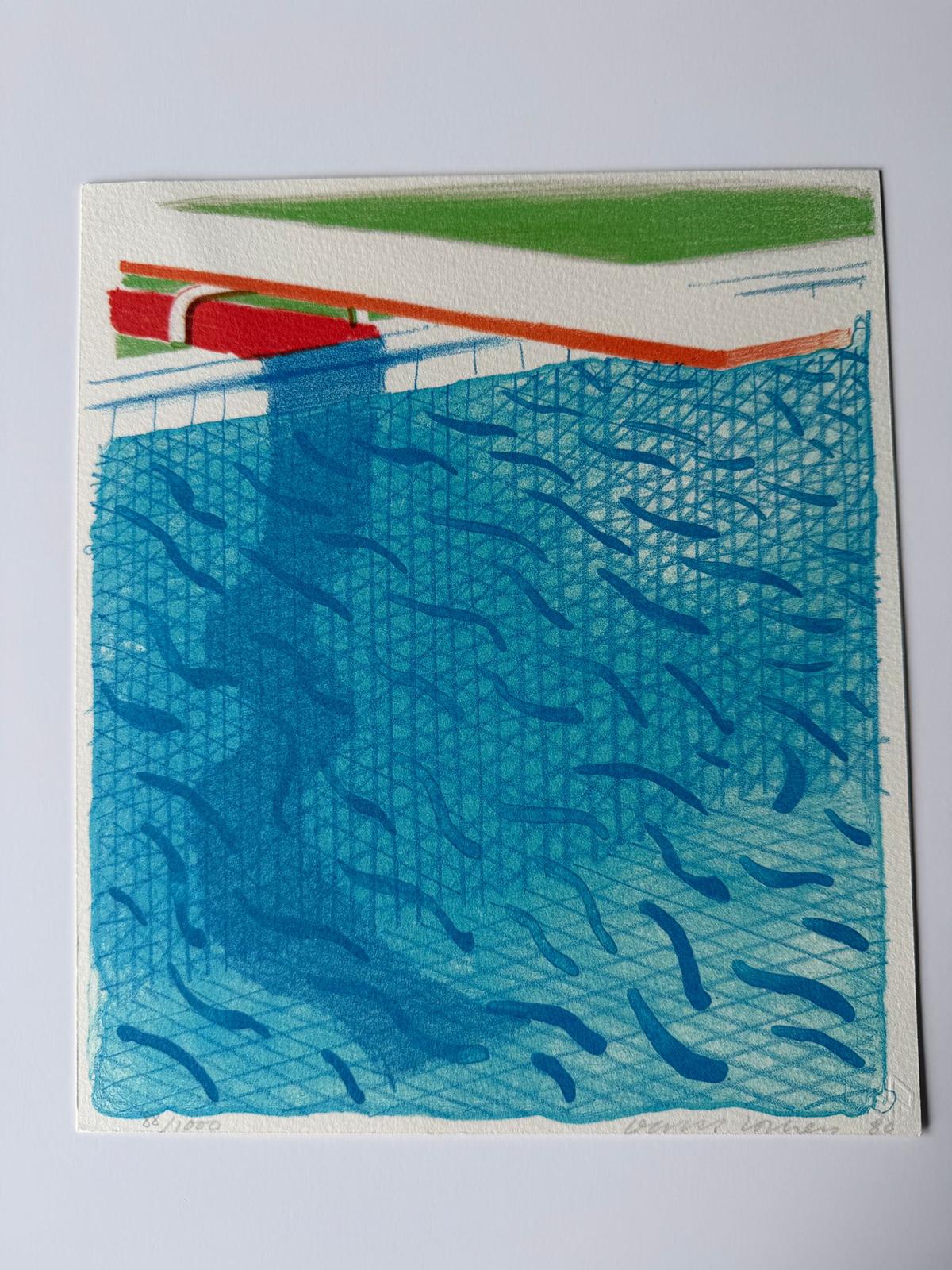
The swimming pool became one of his great motifs, but it should not be understood simply as a glamorous symbol of Californian wealth. Water allowed Hockney to explore reflection, transparency, movement and stillness simultaneously. It is visible but elusive; it distorts the body while reflecting the architecture surrounding it. The pool therefore became almost a laboratory for perception. The brilliant turquoise surfaces, hard Californian sunlight and simplified architecture produced paintings that looked effortlessly pleasurable, but beneath their seductive colour was a sophisticated investigation into how the eye constructs reality.
This is partly why Hockney's colour is so important. His colours do not merely imitate the colours of the world; they reorganise them. Blues become intensely blue, greens unusually vivid, pinks almost theatrical. The result is not necessarily naturalism but something perhaps more interesting: an emotional truth. Hockney wanted his pictures to communicate what it felt like to be somewhere rather than simply to record what that place objectively looked like.
His portraits became equally significant. Friends, lovers, colleagues and acquaintances were rarely treated as anonymous models. They became recurring presences within Hockney's artistic world. The sitter was both individual and participant, somebody whose personality, relationship to the artist and physical position within the composition could all contribute to the meaning of the work. His portraits therefore possess an unusual combination of intimacy and compositional clarity. Hockney looked at people with affection, but he also looked analytically, considering how posture, distance, colour and environment could reveal character.
His relationship with Los Angeles was consequently more complicated than the stereotype of the English artist seduced by Californian sunshine. The city became a place in which Hockney could reinvent himself. It offered an atmosphere of openness that was particularly meaningful to a gay artist developing his identity during the 1960s. California became both geographical landscape and psychological territory.
Hockney's willingness to reinvent himself is perhaps his most remarkable characteristic. When photography became increasingly important to artists, he did not simply use the camera as a recording device. Instead, he questioned what photography could and could not do. His photographic collages, constructed from numerous individual photographs, deliberately disrupted the single viewpoint imposed by conventional photography. The resulting images suggest that reality is not one frozen instant but an accumulation of experiences.
This led to one of the central ideas of his mature practice: human vision is fundamentally different from the mechanical gaze of a camera. We move our eyes. We turn our heads. We remember. We anticipate. We notice different things at different moments. Hockney's multi-perspective works attempt to make that experience visible.
The same restless curiosity shaped his landscapes. His return to Yorkshire in the twenty- first century produced a body of work in which the English countryside became almost psychedelic. Roads, trees, fields and seasons were transformed through exaggerated colour and fractured perspectives. The landscape was no longer the quiet pastoral territory of traditional British painting. It became active, rhythmic and alive. This was especially significant because Hockney's landscapes demonstrate that his interest in perception was never dependent upon California. The Yorkshire countryside could be as visually intoxicating as Los Angeles when approached with sufficient attention. His paintings invite the viewer to slow down and look again. A tree becomes a pattern of branches; a road becomes a line directing the eye; a field becomes a field of colour. Nature is not simplified because Hockney lacks interest in detail. Rather, he searches for another kind of detail: the rhythm and structure through which the eye actually experiences the world.
His experiments extended across painting, printmaking, photography, theatre, opera, video and eventually digital technology. Consequently, asking what medium David Hockney used has no single answer. Painting and drawing form the foundation of his practice, but he also worked extensively with etching, lithography, aquatint, photographic collage, stage design, video and digital drawing. This breadth is not incidental. Hockney has consistently treated the medium as a tool rather than an identity. If one material offered an interesting new possibility, he explored it.
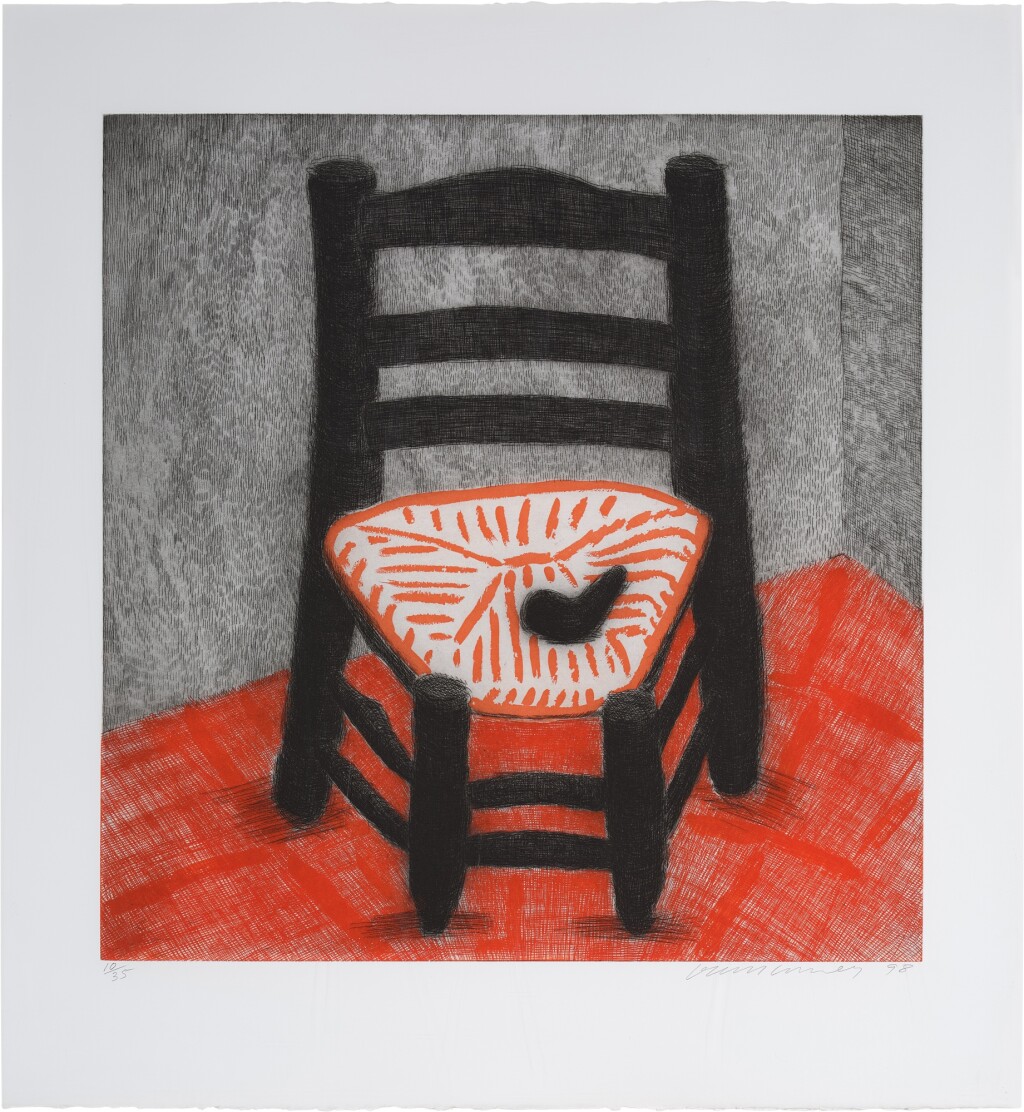
His printmaking is particularly important when considering his later digital work. The connection between the two is much stronger than it might initially appear. In his etchings of the 1990s, including Van Gogh Chair, Hockney demonstrated an extraordinary sensitivity to line. Etching demanded physical commitment: the artist had to construct the image through marks incised into a plate before they could be transferred to paper. Every contour had weight. Every line contributed to the description of form, space and character.
Decades later, the iPad offered an entirely different technical environment, yet Hockney discovered within it something remarkably familiar. The screen became another surface for drawing, allowing the image to appear beneath his hand almost instantaneously. The technology was revolutionary, but the fundamental pleasure was not. He was still using line to translate observation into an image.
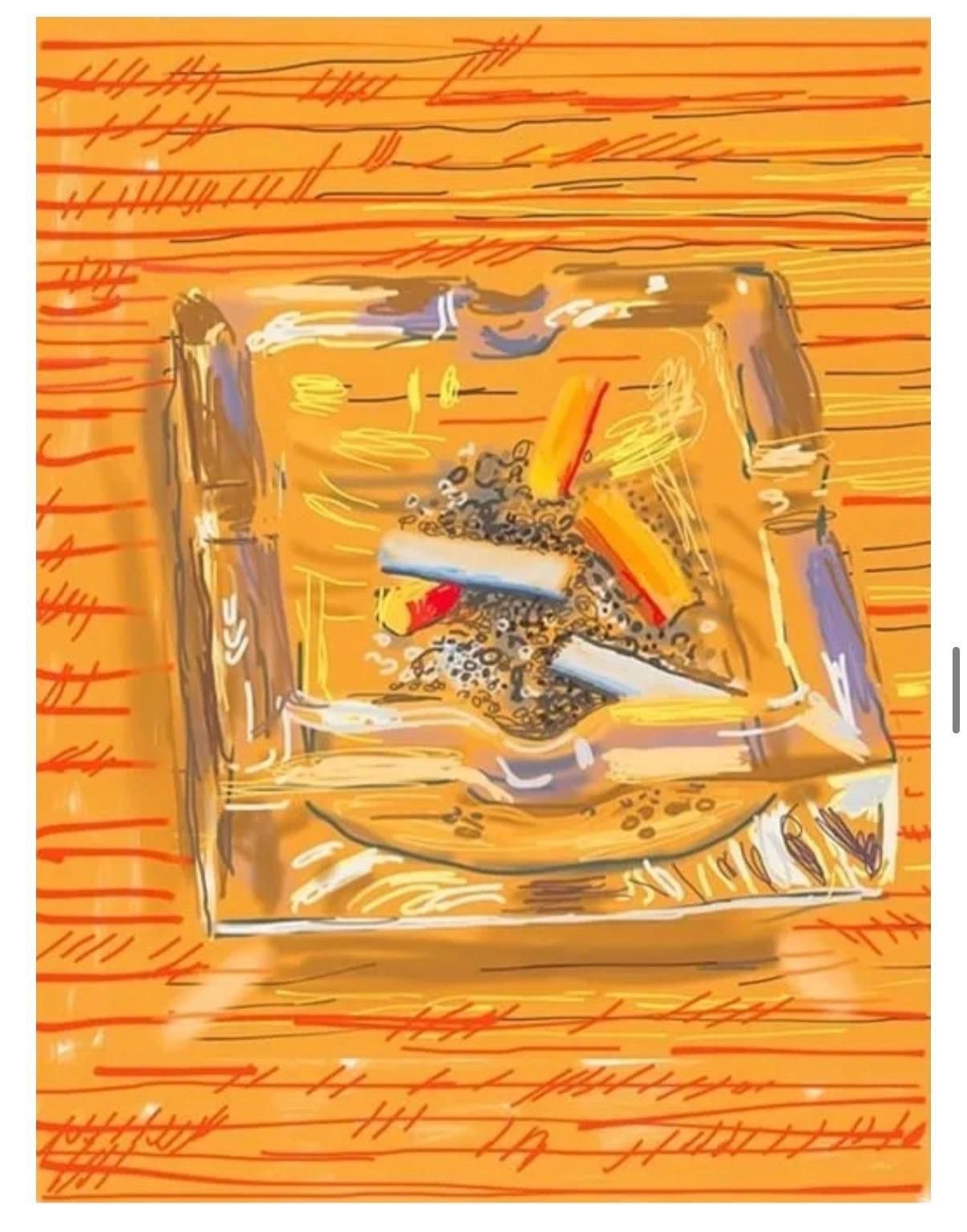
This continuity becomes particularly revealing in Ashtray (2010), one of his early iPad drawings. The subject is deliberately ordinary. Hockney does not require an exotic landscape or monumental figure to justify his attention. An ashtray becomes enough. Its shape, edges, colour and position within space are transformed through concentrated observation.
There is something quintessentially Hockney about this. The ordinary object becomes extraordinary simply because somebody has taken the time to look at it properly. The work is not dependent upon an elaborate symbolic narrative; its pleasure lies in the precision and immediacy of its observation. The digital medium therefore becomes almost invisible. What matters is the act of looking.
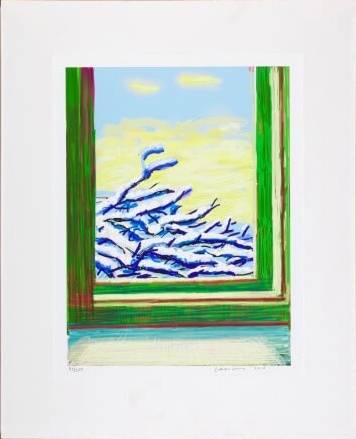
By 2016, Hockney's digital practice had developed into an increasingly ambitious investigation of time and changing perception. My Window No. 610 belongs to the remarkable series of views made from his window in Bridlington. Rather than treating the window as a conventional frame separating interior from exterior, Hockney transformed it into an instrument of observation.
The importance of the series lies partly in repetition. The same view can never remain the same. Weather changes, vegetation alters, light moves across the landscape and the seasons transform the colours of the world. A window therefore becomes more than a view; it becomes a clock.
The number in the title, No. 610, reinforces this sense of accumulation. Hockney was not interested in making one definitive representation of the landscape. He was interested in the continual process of looking. The individual drawing records a moment, while the series as a whole suggests duration. In this respect, his digital drawings extend a concern that had occupied him for decades: how can a static image communicate an experience that is fundamentally moving through time?
There is a beautiful paradox here. The iPad is associated with speed, instant communication and technological acceleration, yet Hockney uses it to slow perception down. The device that could encourage distraction becomes a means of sustained attention. His window drawings ask us to notice things that might otherwise disappear: a particular quality of morning light, the shape of branches, the difference between one season and another.
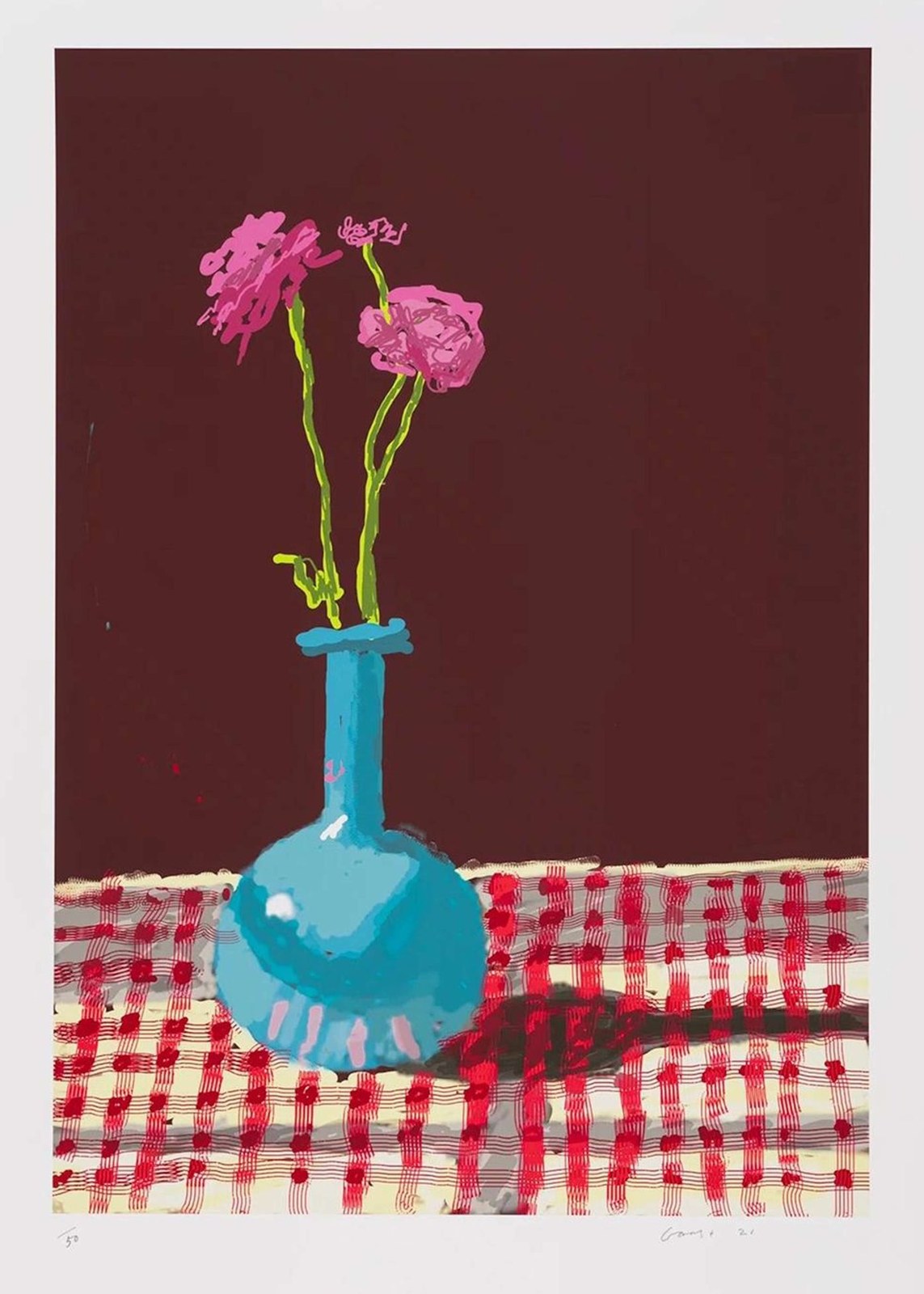
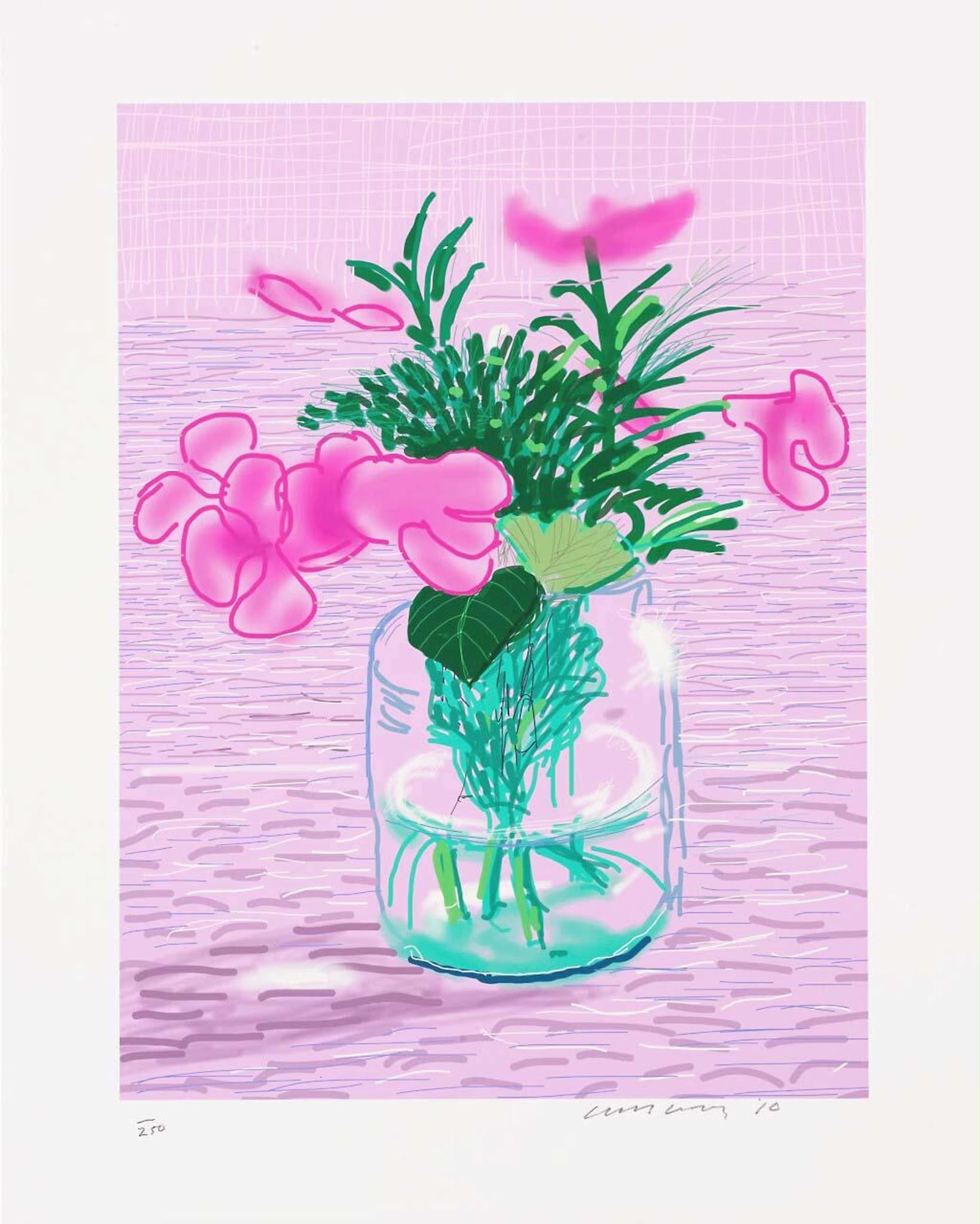
This fascination with observation becomes especially lyrical in Roses in a Blue Vase (2021). Hockney turns towards one of the oldest subjects in European painting—the flower still life—yet the result feels entirely contemporary. Roses have been painted for centuries, but Hockney approaches them through the language he has spent his career developing: bold colour, expressive contour, spatial clarity and an almost joyous confidence in the visual world.
The roses are delicate, layered and transient, while the blue vase provides a strong chromatic anchor. The relationship between the flowers and the vessel becomes an exploration of colour rather than merely botanical description. Hockney's blue does not simply tell us what colour the vase happens to be; it establishes the atmosphere in which the flowers exist.
There is also an unavoidable poetry in the choice of flowers. Roses are temporary. They bloom, alter and eventually decay. Drawing arrests that process. A fleeting arrangement becomes something capable of lasting. Yet Hockney does not need to burden the image with a heavy allegory of mortality. The beauty of the flowers already contains their impermanence.
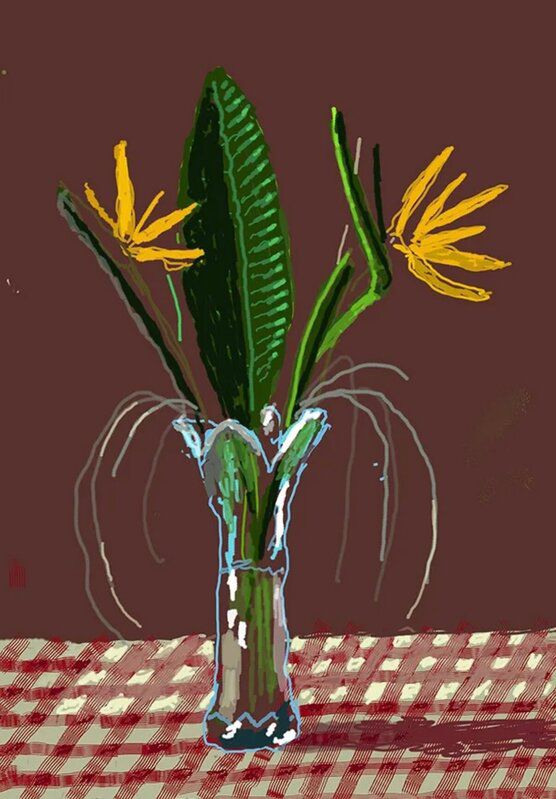
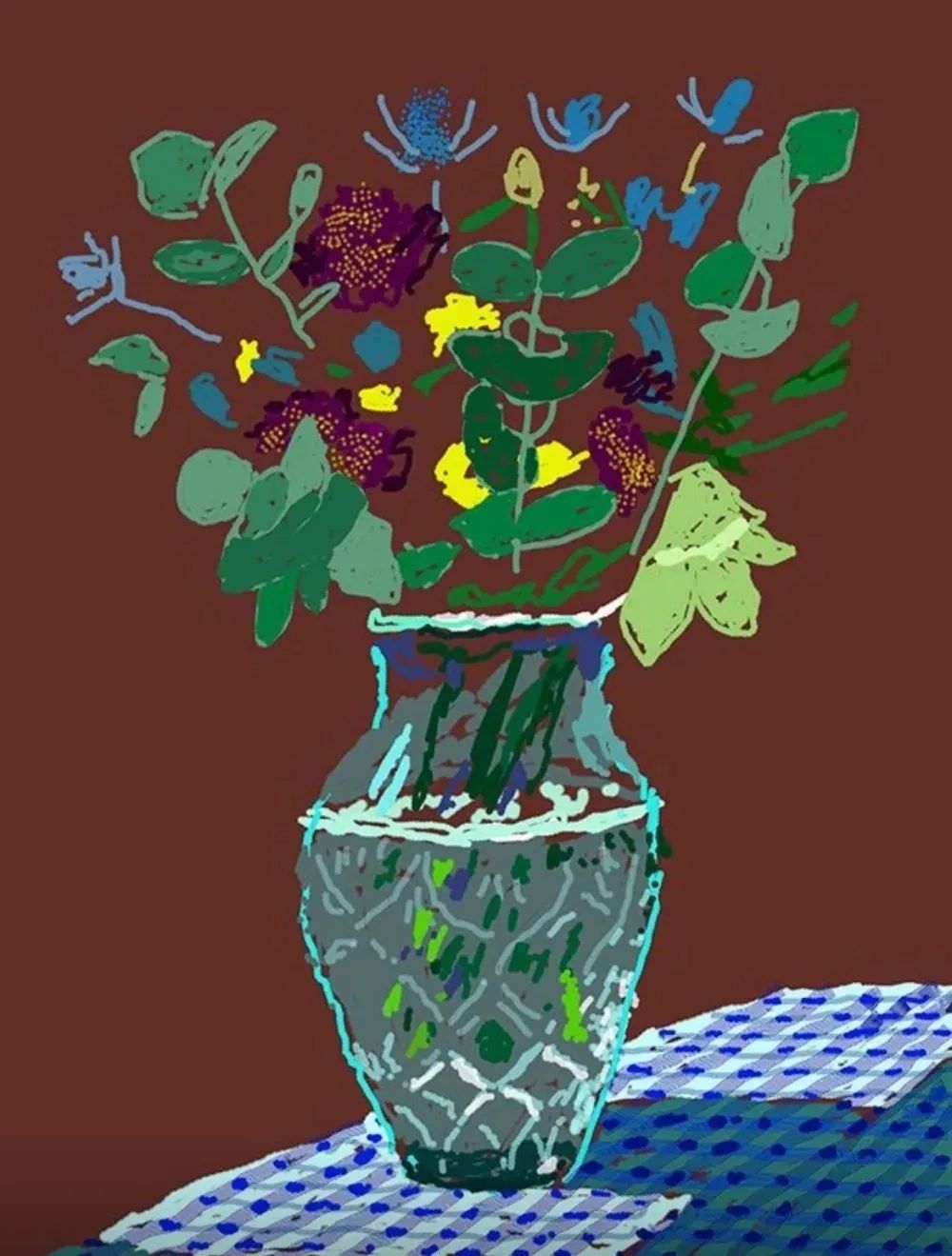
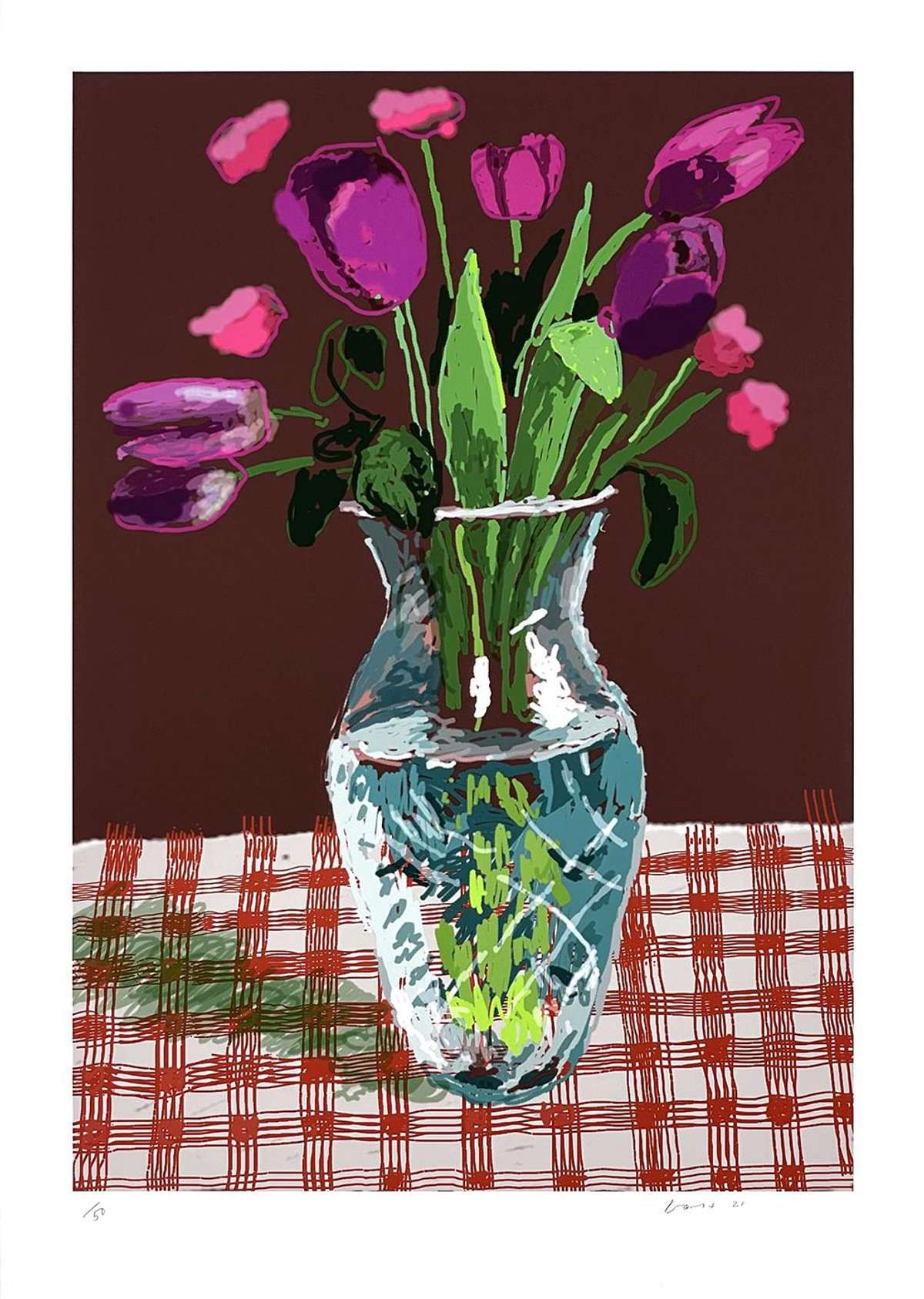
The work demonstrates why Hockney's digital drawings should not be dismissed as technologically convenient alternatives to painting. They are highly considered investigations into the possibilities of line and colour. The iPad provides a luminous surface on which colour can possess a different intensity from conventional pigment. Instead of merely reflecting light, the screen emits it, giving the image an unusual radiance.
The relationship between Roses in a Blue Vase, Ashtray and Van Gogh Chair becomes particularly revealing. The objects are different, the technologies are different and the decades are different, but the underlying impulse remains strikingly consistent. Hockney finds visual richness in things that could easily be overlooked. A chair, an ashtray, a vase of flowers: each becomes a reason to look more carefully.
This is also why Hockney's later work should not be considered an epilogue to his career. It is better understood as a culmination. The young draughtsman from Bradford remains visible within the mature digital artist. The Californian fascination with colour survives within the Yorkshire landscapes. The printmaker's sensitivity to line survives on the illuminated surface of the iPad. The photographer's suspicion of a single viewpoint survives in his changing perspectives.
Even the question of whether Hockney experienced synesthesia must be approached carefully. His intensely coloured paintings and his ability to associate visual experience with music and theatrical atmosphere have sometimes encouraged the suggestion. Yet there is no firm basis for confidently describing him as a synesthete, and Hockney himself rejected the claim when it was put to him. What can be said with greater certainty is that sound, colour and visual sensation often existed in productive proximity within his imagination. His opera designs and his comments about listening to music while working reveal an artist who experienced the senses as deeply interconnected without necessarily possessing clinical synesthesia.
Perhaps the most famous image associated with Hockney remains A Bigger Splash, whose crystalline blue pool, geometric architecture and suspended moment have become almost synonymous with his Californian period. Yet the question of fame becomes more complicated when the art market is considered. Portrait of an Artist (Pool with Two Figures), painted in 1972, has achieved an extraordinary level of recognition and financial significance. In 2018 it sold at Christie's for $90.3 million, establishing a record for a work by a living artist at auction at that time.
Why, then, is Hockney's work so expensive? The answer is not simply fame. The most valuable works combine rarity, provenance, historical importance, recognisability, artistic significance and intense collector demand. Hockney's position within twentieth- and twenty-first-century art has become firmly established, and his most important works are consequently treated as cultural artefacts as much as paintings. Collectors are not purchasing canvas and pigment alone; they are acquiring an object that occupies a significant place within the history of modern art.
There is an intriguing paradox in this extraordinary market success. Hockney's work looks accessible. His pools are inviting, his colours seductive, his landscapes recognisable and his portraits often intimate. But accessibility should never be confused with simplicity. Beneath the pleasure is an unusually persistent intellectual investigation into perception. This may ultimately explain the extraordinary durability of his reputation. Hockney never allowed himself to become trapped by his own success. He could have continued producing variations of the images that made him famous, yet instead he repeatedly changed direction. He returned to Yorkshire. He experimented with photography. He explored huge canvases. He made opera designs. He worked with video. He embraced digital drawing. In his later years, when many artists might have become increasingly conservative, Hockney remained curious.
That curiosity is arguably his greatest artistic achievement.
His death in June 2026 brought an end to a career spanning more than six decades, but the central question that animated his work remains wonderfully unresolved: what does it actually mean to see?
Hockney never offered a single answer. Instead, he produced an enormous visual vocabulary through which the question could continually be reconsidered. The pool, the portrait, the road, the tree, the ashtray, the chair, the window and the vase of roses all became different stages upon which the same investigation could unfold. His art is optimistic without being naïve. It celebrates beauty without abandoning intellectual enquiry. His colours can appear joyous, but the questions underneath them are profound. How does memory alter what we see? How does desire affect perception? Can technology change the way we draw? Can an image represent time rather than merely freezing a moment? Can a picture communicate not only what something looks like, but what it feels like to experience it?
Hockney's career suggests that the world becomes richer when we refuse to accept a single way of seeing it.
That is why his later digital drawings matter so profoundly. Ashtray, My Window No. 610 and Roses in a Blue Vase do not represent an artist abandoning painting for technology. They represent an artist continuing the same lifelong pursuit through a new vocabulary. The iPad did not replace the draughtsman's hand; it gave that hand another surface. The screen did not replace observation; it intensified it.
Ultimately, Hockney's greatest subject was never simply California, Yorkshire, flowers, people or colour. It was perception itself. He spent his life demonstrating that seeing is an active, imaginative process rather than a passive reception of reality. His legacy therefore lies not only in the extraordinary pictures he left behind, or in the millions paid for them, or in his position within the canon of modern art. It lies in something more generous.
He taught generations of viewers to look again.
And perhaps that is the most Hockney-like achievement of all: to take the familiar world— the blue of a pool, the branches outside a window, a chair, an ashtray, roses in a vase— and make it feel, somehow, newly discovered.